

- No products in the cart.
✨ 4 new products > How are you going to show up today? Shop Mirror Clings
I can’t do it. It’s too hard.
My daughter was 5, and she was learning to ride her bike. After several tries, those two lines had become her soundtrack.
As her frustrations mounted, she got back on the bike. Her body language told me that this time wasn’t going to be any different. I paused her for a moment, and shared, “Did you know, your brain is like a super listener? It hears every word you’re saying right now and believes it. So when you say, ‘I can’t do it,’ your brain says, ‘Okay, then we can’t.'” Then, I asked her to shift her words to I’ve got this.
She was reluctant, which is a fair reaction. I asked her to try it just this one time.
She climbed back on the bike, whispering to herself. I’ve got this. I’ve got this.
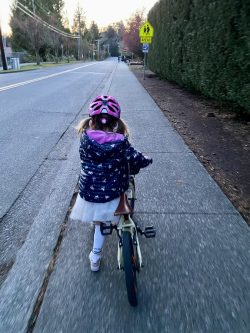
She pushed off, a bit wobbly. Then all of a sudden, she pulled her feet up and pedaled! She made it to my husband who was waiting for her on the sidewalk a few houses down. Somewhere along the way the whisper began to grow, louder and louder until yelling: “Dad! I’ve got this! Look, I’ve got this!”
Was it the words? Maybe. It could have been luck, or the right amount of momentum on the right try. But it was a mindset shift. And, a delightful moment that has stuck with me after all these years.
Affirmations can feel a little awkward at first, and I get it. But I think of them as a way to practice talking to myself with the same kindness I’d offer someone I care about. When you hear a message often enough, especially from yourself — it starts to shape how you see the world and your place in it. It can also interrupt old patterns of self-criticism and make room for healthier ones.
There’s research behind this, too. Studies on self-affirmation suggest that reminding ourselves of what we value and who we are can take the edge off stress. When a challenge feels less like a threat, we’re more likely to stay open and keep trying instead of getting defensive or giving up.
There is a catch. In a study led by Joanne Wood at the University of Waterloo, people with low self-esteem felt worse after repeating “I am a lovable person” to themselves, while people with high self-esteem felt better. The reason? The statement didn’t match how the first group saw themselves. Your brain may be a super listener, but it’s also a very good fact-checker.
That’s the difference between an affirmation that works and one that doesn’t ring true. The words have to be believable to you.
“I’ve got this” wasn’t a claim that she’s was an amazing bike rider. It didn’t promise she won’t fall. It just says that right now, she’s going to confidently try. That’s something we all can believe.
Before leaving for camp last week, my daughter was a little nervous about sleeping in a cabin with three girls she didn’t already know.
The night before she left, I found her downstairs writing a list of affirmations in her notebook to use when doubt showed up:
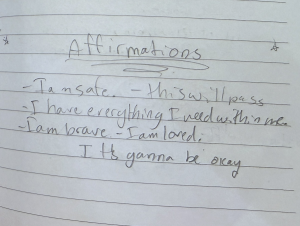
When I read this list, it reminded me of our that bike ride 5 years ago and how she has carried this tool forward. She has her own list that delivers her comfort and confidence. Not one of them says “I’m the most confident kid at camp.” Each one delivers her something slightly different in her moment of need.
She left the next morning, and of course, as a mom, I was a little nervous for her. But, I knew she was capable, confident, and ready for this adventure. In the end, she had a blast!
We all have moments we that hit us hard. Sometimes it’s changes we’ve gone through, like a little extra weight after pregnancy, or aging overtime. Sometimes it’s bigger — like something challenging with our health. Sometimes we are trying to achieve an ambitious goal, like nailing a sales pitch or training for a marathon. And, sometimes we have a feeling that we’re just in over our heads. It’s in these moments we doubt ourselves. Am I beautiful enough? Am I brave enough? Am I strong enough? Am I… enough?
This is where affirmations can help. I like to think of mine as power phrases: short, supportive statements I can come back to when I need them most. Something like “One step at a time” or “I am learning.” These words don’t make the hard thing disappear, but they can help soften the edges. They also give us a small nudge to slow down, breathe, and reconnect with what matters.
If you’d like to a power phrase, here’s a simple way to start:
A good power phrase is:
And, if your words don’t feel authentic, keep working with them until they’re yours.
Put your power phrase where you can see it.
Personally, I like my bathroom mirror. It’s where the day starts, where you get one last look before you head out the door, and where you end your day.

It’s why I’ve created mirror clings. If one of them resonates with you — great!
But if not, create your own and find a spot that you’ll see it every day. A sticky note on your laptop, the wallpaper on your phone, or the inside cover of a notebook, your rearview mirror in your car. Find what works for you.
Think:What’s one sentence you wish someone had said to you the last time you doubted yourself?
Try this: Create your own power phrase. Write it down and put it where you’ll see it and say it out loud once. Even a whisper counts!
